How ArdiQ works
Three parties are involved in every task: the producer that enqueues it, Redis, and a worker that runs it. All durable state lives in Redis. A worker holds nothing that matters if it dies, which is what makes the recovery story below possible.
This page is the mechanism. If you only want to write tasks, Defining tasks is the page you want.
The path of a task
Section titled “The path of a task”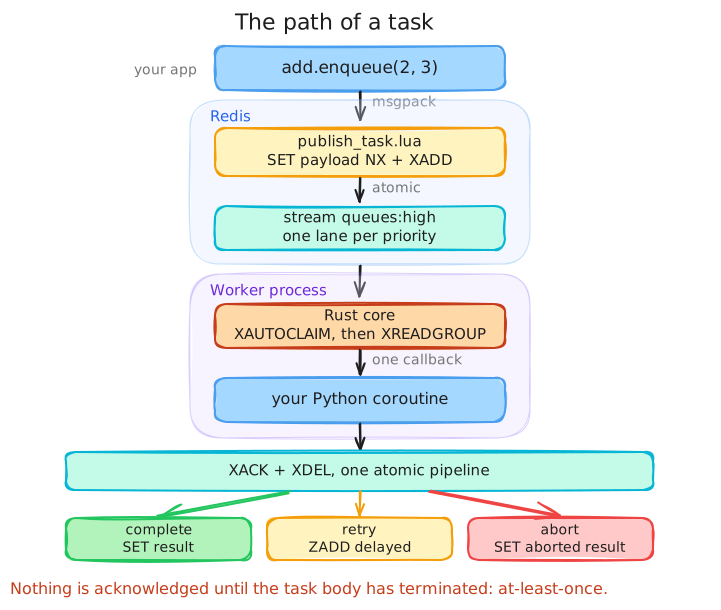
Stage by stage:
-
Enqueue. Arguments are serialized (msgpack by default) and handed to the Rust core, which runs one Lua script: the payload is stored under
task:data:<id>withSET ... NXand, in the same script, the task id is either appended to the priority’s stream or added to that priority’s delayed sorted set if it has a fire time. One round trip, all or nothing. Bulk enqueues run a sibling script that does the same per task, up to 1,000 tasks per invocation. -
Pickup. Each worker runs a producer task that polls the streams in priority order, highest first. Every poll issues
XAUTOCLAIMbeforeXREADGROUP, so work stranded by a dead worker is preferred over fresh work. When nothing is waiting, it falls back to a blockingXREADGROUPacross all lanes rather than spinning. -
Dispatch. Messages cross a bounded channel to the consumer tasks, one per concurrency slot. The consumer increments the attempt counter, adds the task to the running set, and reads the payload and the abort marker in a single pipelined round trip.
-
Execution. The core calls into Python once per task, through a single async callback, and awaits the resulting future.
async deftasks run on the event loop; blockingdeftasks are pushed to a thread withasyncio.to_threadso they never freeze the worker. -
Finish. The outcome comes back as one of three codes, and each one is a single atomic Redis pipeline: complete acknowledges the entry and writes the result, retry acknowledges it and puts the task back in the delayed set with its backoff, abort completes it with an aborted result. Every one of them starts with
XACK.
Delivery semantics: at-least-once
Section titled “Delivery semantics: at-least-once”ArdiQ delivers each task at least once. A task can run more than once. It will not be silently dropped.
The guarantee comes from where the acknowledgement sits. XACK appears in exactly three
places in the core, and all three run after the task body has terminated, in the same
atomic pipeline that writes the result or reschedules the retry. No code path acknowledges
an entry before running it.
Until that XACK, the entry stays in the consumer group’s pending list with the worker’s
name on it. If the worker dies, the entry is still there, and after
idle_timeout_ms another worker reclaims it
with XAUTOCLAIM and runs it again. Losing a worker costs you a repeat, never a task.
So a task runs twice when:
- a worker dies mid-task:
SIGKILL, an OOM kill, or the machine going away, - a worker gets wedged badly enough that its heartbeat stops while the task keeps running.
A retry is not a duplicate in this sense. It is a deliberate redelivery of the same task id,
and tries counts up across all of them.
ArdiQ does not offer exactly-once, and neither does any other queue that crosses a process boundary. The honest version of that promise is always at-least-once delivery plus effects that tolerate a repeat.
One consequence worth knowing: the attempt counter is incremented at pickup, not at
failure, so a reclaimed task does not get a fresh retry budget. A task that fails after a
reclaim resumes counting where the dead worker left off. The exception is a task that takes
the whole process down every time it runs, before any Python code can decide anything: that
one gets reclaimed indefinitely, because nothing ever reports an outcome. If you have a task
that can hard-kill a worker, cap it with a
timeout or keep it out of the queue.
Why the writes go through Lua
Section titled “Why the writes go through Lua”Four operations run as Lua scripts, and each one is a decision plus several writes that must not interleave with another client.
Staging a task. The payload and the queue entry have to land together. Store the payload
without queueing and the task never runs; queue without the payload and a worker picks up an
entry whose data is not there. The SET ... NX also decides whether this id is new, and
that decision has to be fused to the XADD, or two concurrent enqueues of a
unique=True task both stage.
Promoting delayed tasks. Moving due tasks into the stream is a ZRANGE ... BYSCORE, then
a ZREMRANGEBYSCORE, then an XADD per task. Two workers doing that concurrently without
atomicity both read the same due set and enqueue every task twice.
Aborting. An abort resolves differently depending on where the task is at that instant: running, waiting in a delayed set, or sitting in a live stream. The state can change between the check and the write, so the whole thing is one script.
That last case is also why an abort leaves a marker rather than deleting the entry: a stream entry can only be removed by the consumer that reads it. A queued task keeps its place, and the worker honors the marker at pickup, reading it in the same round trip as the payload.
Crash recovery
Section titled “Crash recovery”Workers sharing a queue_name join one Redis consumer group per priority stream, each under
its own consumer name. Entries that have been read but not acknowledged sit in that group’s
pending list.
A dedicated heartbeat task runs at 90% of idle_timeout_ms and does two things: it refreshes
the worker’s health key, and it issues XCLAIM ... JUSTID over every message the worker is
currently holding, which resets those entries’ idle timers.
That second half is what makes long tasks safe. Without it, any task running longer than
idle_timeout_ms would be stolen and run a second time while the first was still going. With
it, “idle” means the worker holding this stopped reporting, not this is taking a while.
Backpressure
Section titled “Backpressure”A worker starts with prefetch permits. The producer task only ever asks Redis for as many
entries as it has permits, and when it runs out it parks instead of reading. Each consumer
returns a permit when its task finishes and wakes the producer.
The channel between them is bounded at prefetch as well, so the two bounds agree. The
practical effect is that a worker never holds more than prefetch unacknowledged entries.
That caps its memory, and it caps how much work is stranded in the pending list waiting on a
reclaim if the worker dies.
Where Rust ends and Python begins
Section titled “Where Rust ends and Python begins”The two sides meet at exactly one function: a callback taking (task_id, payload, tries, aborted) and returning (outcome, result_bytes, retry_ms).
The core attaches to the interpreter to build the coroutine, converts it to a Rust future, awaits that future, then attaches once more to read the returned tuple. Everything between those two attaches, which is your task actually running plus every Redis round trip around it, happens without the core holding the GIL. The loop, the polling, the delayed-task promotion and the reclaim logic never touch the interpreter at all.
Two GIL acquisitions per task, each measured in microseconds, is the whole per-task cost of the boundary. That is where the dispatch numbers come from: ArdiQ crosses a language boundary twice per task and still spends less time per task than the pure-Python queues that never cross anything.
The Redis keyspace
Section titled “The Redis keyspace”Every key is namespaced by queue_name, so unrelated workloads can share one Redis. With
Ardiq(queue_name="emails") the prefix is ardiq:emails.
| Key | Type | Holds |
|---|---|---|
:queues:<priority> | stream | live entries for one lane |
:queues:delayed:<priority> | zset | delayed, scheduled and retrying tasks, scored by fire time |
:task:data:<id> | string | the serialized call, deleted when the task finishes |
:task:results:<id> | string | the result envelope, TTL from result_ttl_ms |
:task:retry:<id> | string | attempt counter, incremented at each pickup |
:task:abort:<id> | string | abort marker, honored at pickup |
:index:running | set | task ids executing right now |
:index:results | zset | result ids by expiry, swept by the heartbeat |
:health:<worker_id> | string | worker heartbeat, expires after idle_timeout_ms |
:result:channel:<id> | pub/sub | published when a result lands, so await job.result() does not poll |
:abort:channel | pub/sub | published on abort, so a running task can be cancelled |
The consumer group on every stream is named workers.
Next steps
Section titled “Next steps”- Handling failures for retries, backoff and error hooks.
- Running a worker for concurrency, prefetch and shutdown.
- Performance for what all of this buys, measured against five other queues.
Made bytay.dev